

Words: Associations Word Game
MEGARAMA
I went into Words: Associations Word Game expecting a simple word exercise, but I found a more deliberate kind of puzzle than its brief name suggests. The central task is to identify four words that share a connection, then use that relationship to complete the puzzle. That sounds easy until the obvious link turns out to be only part of the answer. The game works best when I slow down, test several interpretations, and resist the temptation to force the first pattern I notice.
That makes it a comfortable fit for short sessions. I can open it when I have a few quiet minutes, solve a puzzle, and stop without feeling that I have abandoned a long campaign. At the same time, the word groups can create a surprisingly stubborn mental snag, especially when one term seems to belong to two possible categories. My overall impression is that this is a focused word game for people who enjoy connections, language, and small moments of deduction rather than fast reactions or elaborate progression systems.
How Words: Associations Word Game feels in everyday play
A calm first impression built around the puzzle itself
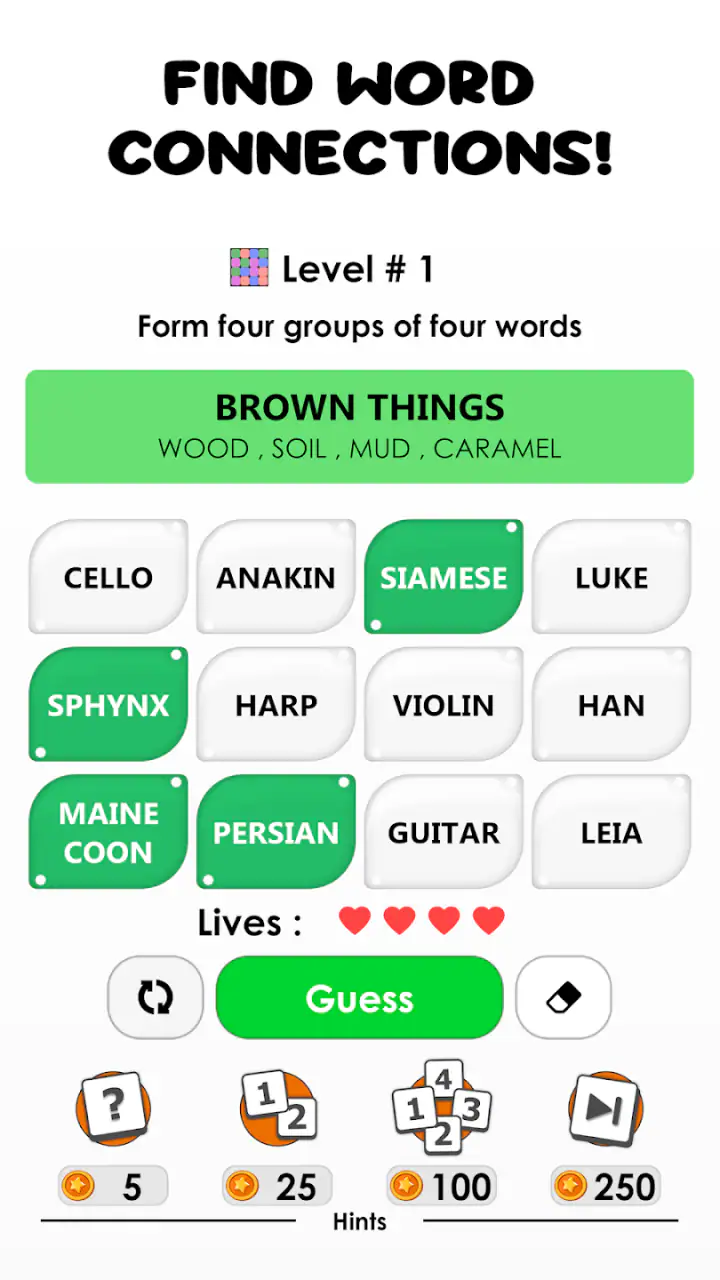
The strongest part of the opening experience is its clarity. There is no need to learn a complicated control scheme or understand a fictional setting before playing. The board presents words, and my attention immediately goes toward meaning, spelling, usage, and association. That directness is valuable because it keeps the game from distracting me with systems that do not serve the central challenge.
MEGARAMA has positioned the game as a free title, which makes it easy to try without committing money at the start. It is listed for Everyone, so the concept is approachable for a wide age range. I would still describe the difficulty as more dependent on vocabulary and flexible thinking than on age. A younger player may enjoy the discovery aspect, while an experienced word-game player may focus more on the precision of the categories.
The game has attracted over one hundred thousand installs and holds a 4.5 average from around two thousand ratings. Those figures suggest that the basic format has found an audience, but they do not remove the need to judge whether this particular style suits you. If you prefer word searches, anagrams, or crossword clues with a clear route to the answer, the association format can feel less predictable. If you enjoy spotting hidden relationships, its uncertainty is exactly the appeal.
Related News






The visual language keeps the focus on meaning
What stands out to me is how the presentation supports a language-first mood. The words are the important visual objects, not decoration around them. That gives each puzzle a clean mental space: I am not scanning a busy scene or waiting for an animation to reveal the next clue. The restrained approach makes the game feel closer to a daily thinking ritual than to a conventional arcade experience.
That simplicity also creates a trade-off. Players who want a strong fictional world, expressive characters, or a sense of place may find the setting deliberately thin. There is no need for a dramatic backdrop when the challenge is semantic, but the lack of a larger narrative atmosphere means the game depends almost entirely on the quality and variety of its word relationships. For me, that is acceptable because the uncluttered presentation helps me notice connections that I might overlook in a more theatrical game.
The visual design also affects pacing. A puzzle can sit in front of me without demanding immediate action, so I can examine one word, move to another, and return to the first after forming a new theory. That pause-friendly structure is useful during a commute, a coffee break, or a short rest between tasks. It is less suitable if I want constant visual movement or a strong sense of momentum.
Gallery
Sound and rhythm are quiet rather than dramatic
The mood comes mainly from the act of thinking. This is not the kind of game I play for a memorable soundtrack or a cinematic audio identity. Its rhythm is created by reading, grouping, making a choice, and checking whether the relationship holds. That quiet cycle suits the subject matter: a loud or urgent presentation would work against the reflective quality that makes association puzzles enjoyable.
I appreciate that the format leaves room for my own concentration. I can treat a puzzle as a quick mental reset or stay with it longer when a category is resisting me. The lack of a forced rush makes the experience more welcoming to players who need time to process language. It also means that the game may feel too subdued for anyone who expects sound effects and rapid rewards to carry the session.
One practical consequence is that I do not rely on audio to understand what is happening. The words and the act of connecting them carry the experience, so the game remains readable when I am playing in a quiet public place or with the sound turned down. That is a small but meaningful strength for a title designed around brief, flexible sessions.
Why the four-word connection creates useful tension
The mechanical idea is simple, but the interesting part is the ambiguity. A word can suggest a category because of its meaning, its common usage, a phrase it appears in, or a relationship with the other terms. When several possible links are visible, I have to decide which one is broad enough to include all four words without becoming vague. That is where the game separates careful reasoning from random guessing.
My most useful habit is to look for the strongest pair first, then deliberately search for the other two instead of declaring the category too early. A pair can be misleading, especially when the same word has multiple everyday meanings. I also try to describe the connection in one short sentence before committing. If I cannot explain why every word belongs, I probably have a tempting partial answer rather than the intended group.
Another effective approach is to mark the outlier mentally. When three words appear to share a clear relationship, the fourth often reveals whether the category is correct or whether the first three are merely a coincidence. This makes the puzzle feel less like vocabulary recall and more like evidence testing. The game rewards the player who can revise a theory without becoming attached to it.
That design gives the title more replay value than a basic list of definitions. I am not simply asking whether I know a word; I am asking how several words behave together. The challenge can therefore suit people with different strengths. Someone with a broad vocabulary may solve quickly, while someone with strong lateral thinking may compensate when an unfamiliar term appears.
The daily structure works best as a routine
The game offers unlimited daily word puzzles, and that combination shapes how I use it. I can make it part of a regular routine rather than treating it as a one-time collection of levels. A practical scenario is opening it after breakfast, attempting the current puzzle without rushing, and returning later if one category still feels uncertain. The short format makes that habit easy to maintain.
The word “daily” also gives the experience a gentle sense of occasion. Even when I only spend a few minutes with it, the puzzle feels like a small appointment with my attention. The unlimited aspect is useful when one challenge is not enough, although players who prefer a carefully paced finite campaign may find the open-ended format less satisfying.
I would not choose this game as my main option for competitive play. Its pleasure comes from private deduction, not from reflexes or a large social spectacle. It is better for a quiet solo break, a family discussion around possible categories, or a friendly comparison of how different people interpret the same words.
Where it fits among familiar word-game alternatives
Compared with a crossword, this game usually gives me less supporting context and asks me to discover the relationship rather than fill a defined clue. Compared with an anagram game, it is less about rearranging letters and more about meaning. Compared with a word search, it does not reward scanning for hidden spelling patterns. Those differences matter because the right alternative depends on what kind of mental activity I want.
I would pick this title over a crossword when I want a compact challenge without committing to a large grid. I would choose an anagram game when I am in the mood for letter manipulation and quick trial and error. I would choose a crossword when I want richer clues, broader subject matter, and a longer solving session. Words: Associations Word Game occupies the middle ground: accessible to begin, but capable of becoming demanding when the categories overlap.
Its main weakness in comparison is that an association can sometimes feel subjective. A crossword generally tells me what kind of answer it expects through its clue and crossing letters. Here, I may understand a plausible connection but still wonder whether it is the intended one. That uncertainty is central to the format, yet it can frustrate players who prefer unambiguous feedback and a clearly signposted path.
Who will enjoy it, and who should skip it
I recommend it to readers who like wordplay, lateral thinking, and puzzles that can be paused without penalty. It is especially suitable for someone who wants a lightweight daily habit rather than a large game to manage. Teachers, families, and language learners may also find the format useful as a conversation starter, because discussing why words belong together can be as interesting as solving the group.
I would be more cautious about recommending it to players who need a strong story, character development, or a visually rich setting. The game’s atmosphere is intentionally quiet and its identity comes from the word relationships. I would also steer away from it if you dislike ambiguity or become irritated when a familiar word can be interpreted in several ways.
Players should also consider the monetization before settling in for regular use. The game is free to start, while in-app purchases range from around three dollars to twenty-five dollars per item. That does not change the core appeal of the puzzle concept, but it is worth remembering if you prefer completely unmonetized experiences or want to avoid accidental spending during a casual session.
Small strategies that make difficult puzzles less frustrating
When I am stuck, I stop trying to solve the whole board at once. I sort the words by confidence: words with an obvious relationship go in one mental group, words with several meanings stay undecided, and isolated terms become clues rather than problems. This reduces the feeling that every word must be explained immediately.
I also test categories at different levels of specificity. A group based on a very broad idea may technically fit several words but fail to explain why those particular words were selected. A narrower relationship is usually more convincing when it accounts for all four without extra excuses. This is a useful distinction because it prevents me from accepting a category merely because it sounds clever.
Finally, I treat mistakes as information. If a proposed connection collapses, I ask which word broke it and what alternate meaning that word might have. That approach turns a failed attempt into a clue for the next one. It also makes the game feel more educational than a simple right-or-wrong exercise, since I become more aware of how context changes the meaning of ordinary language.
Device requirements and long-term appeal
The current version is 3.2.1, and it runs on devices using Android 6.0 or later. That gives the game a broad technical reach for Android users, particularly those who do not replace their phone frequently. Because the experience is built around reading and selecting words rather than demanding complex graphics, it feels naturally suited to a wide range of screens.
For long-term use, the important question is not whether the controls are difficult but whether the puzzle relationships continue to feel fresh. The daily format helps establish a habit, while the unlimited supply gives me a reason to return beyond a single completed session. Still, anyone who plays many word games in succession may eventually want variety, since even a well-designed association format can feel mentally similar from one session to the next.
The rating of Everyone makes it broadly approachable, but the best audience is defined more by taste than by age. A player who enjoys discussing language may get more from each puzzle than someone who only wants quick rewards. That is why I see it as a thinking companion rather than a universal word-game recommendation.
My atmosphere verdict after spending time with it
Words: Associations Word Game creates a coherent mood by keeping its art direction, sound, and pacing subordinate to the act of making connections. It does not try to turn a word puzzle into an adventure world. Instead, it gives the language room to be the setting. The quiet presentation supports concentration, the flexible rhythm respects different solving speeds, and the four-word structure supplies enough uncertainty to make each answer feel earned.
Its limitations are equally clear. The experience may feel visually spare, sonically understated, and occasionally subjective. It is not the right choice for a player seeking narrative progression, competitive intensity, or the tightly guided logic of a crossword. The purchase options are another consideration for anyone who wants a completely free experience from beginning to end.
For me, the game succeeds because it turns ordinary words into a compact reasoning exercise. I can play it during a short break, return to a difficult puzzle later, or talk through a possible category with someone else. That flexibility is more valuable than flashy presentation here. If you enjoy finding the hidden rule that makes several unrelated words belong together, this is an easy game to keep in your daily rotation.
MEGARAMA’s title is best approached with patience rather than speed. I recommend beginning with the free experience, paying attention to how much you enjoy ambiguity, and using the grouping strategies above when a puzzle resists you. If that style of thinking feels rewarding, the game offers a focused and pleasantly quiet way to exercise your vocabulary and pattern recognition.
FAQs for Words: Associations Word Game
What is Words: Associations Word Game?
Words: Associations Word Game is a word puzzle built around finding connections between related terms. Instead of simply spelling words or solving traditional crosswords, you examine a collection of words and group them according to a shared idea, category, theme, or association. The game is designed to test vocabulary, lateral thinking, and pattern recognition while offering short, accessible rounds suitable for casual play.
How do you play Words: Associations Word Game?
Each puzzle presents a selection of words that must be organized into groups based on their relationship. Some connections are obvious, while others are deliberately less direct and require careful thought. You normally select the words you believe belong together and submit the group. Correct choices reveal progress, while incorrect attempts encourage you to reconsider overlapping or misleading associations before using another try.
Is Words: Associations Word Game free to download and play?
The game can generally be downloaded and played without an upfront purchase, although the exact availability of free content, advertisements, hints, or optional purchases may depend on the version and platform. Players should check the app-store listing before installing to review pricing details, in-app purchase information, and subscription terms. This is especially important if the game is being used by children.
Does the game work offline?
Many word puzzles can be played without a constant internet connection once the necessary game content has loaded, making Words: Associations Word Game convenient for travel or areas with limited connectivity. However, features such as advertisements, cloud synchronization, updates, leaderboards, analytics, or newly delivered puzzles may require internet access. Offline behavior can vary between Android and iOS versions, so testing the app after installation is recommended.
Who is Words: Associations Word Game suitable for?
Words: Associations Word Game is best suited to players who enjoy vocabulary challenges, category puzzles, and quick mental exercises rather than action-oriented gameplay. It can appeal to teenagers and adults, including people looking for a relaxing daily brain teaser. Difficulty may increase as the puzzles progress, and some clues can depend on cultural knowledge or word familiarity, so younger players may occasionally need assistance.
Pros
- Simple rules make it easy to start playing immediately.
- Short rounds are ideal for quick breaks or casual sessions.
- Improves vocabulary and encourages creative word connections.
- Clean interface keeps the focus on solving each association.
- Suitable for solo play without requiring opponents or matchmaking.
Cons
- Some puzzles may feel subjective when several answers seem possible.
- Difficulty can vary noticeably between consecutive rounds.
- Hints or extra assistance may be limited without in-app purchases.
- Repeated word themes can reduce the challenge over longer sessions.
- Offline availability may differ depending on the app version or mode.


